Corporate video has a reputation problem. Companies spend five figures on a production, the file sits on a SharePoint folder, and no one can quite explain what it was meant to achieve. This guide cuts through the process so you know what to commission, why, and what to expect at each stage.
What Corporate Video Actually Covers
The term "corporate video" is a catch-all. In practice it spans at least eight distinct formats, each with different production requirements, crew sizes, and post-production complexity.
| Format | Typical Length | Primary Use | Relative Cost |
|---|---|---|---|
| Brand / company overview | 90 sec – 3 min | Website homepage, investor decks | Medium |
| Product demonstration | 1 – 4 min | Sales enablement, e-commerce | Medium |
| Testimonial / case study | 1 – 2 min | Bottom-of-funnel conversion | Low–Medium |
| Internal comms / training | 3 – 15 min | HR, onboarding, compliance | Low–High (depends on volume) |
| Live event capture | Varies | Conference, award ceremony coverage | Medium–High |
| Broadcast-standard commercial | 20 – 60 sec | TV, SVOD pre-roll | High |
| Showreel / sizzle reel | 60 – 90 sec | Pitching, trade shows | Low |
| Behind-the-scenes / culture | 2 – 5 min | Recruitment, employer branding | Low–Medium |
If a production company quotes a single price without asking which of these you need, that is a red flag.
Why Most UK Corporate Videos Underperform
The problem is rarely the camera work. It is almost always one of three things:
- No defined audience. A video made for "stakeholders, customers, and the team" serves none of them well.
- Brief written by a committee. Four departments add objectives; the final video tries to cover all of them in two minutes.
- Distribution treated as an afterthought. The video is approved and then someone asks where it should go.
A 2024 Wyzowl survey found that 89% of businesses use video as a marketing tool, but fewer than half have a documented distribution strategy at the point of commissioning. The production budget is spent; the placement budget is not.
Pre-Production: Where the Money Is Actually Saved
Pre-production is the phase most clients want to rush. It is also where overruns originate. A structured pre-production process for a standard corporate video in the UK typically takes two to four weeks and covers:
Script and messaging. The script is not a formality. For a 90-second video, every word carries weight. A good production team will push back on scripts that try to mention the company history, three product lines, and a call to action within the same piece.
Location scouting. Office spaces look flat on camera without planning. Acoustic treatment, ambient light direction, and background depth all need to be assessed before the shoot day. Sending a crew to a location without a recce adds hours of setup time and usually adds a day rate to the invoice.
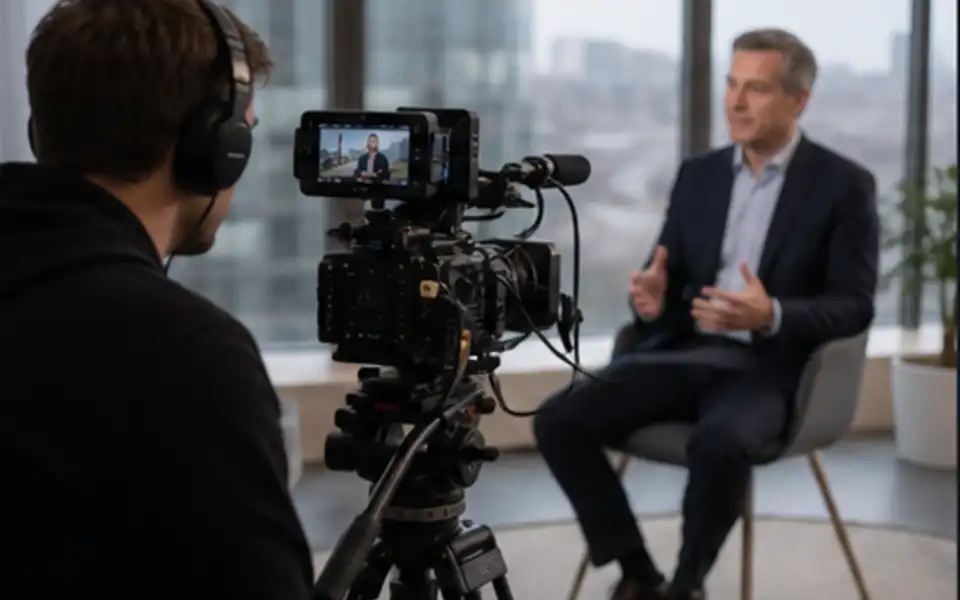
Talent and interviewees. If the video involves interview-style talking heads — common in case studies and brand overviews — prepare the subjects. People who are not broadcast-trained need direction, and that takes time on the day. Briefing them beforehand on key messages and approximate question structure cuts average interview time by 30–40%.
Shot list and schedule. A professional shoot day in London or Manchester runs at a day rate that, with a crew of three and basic kit, starts around £1,500–£2,500. Every unplanned element on shoot day costs against that rate.
Production: What a Professional Crew Brings
The gap between a DSLR-shot internal video and a broadcast-standard production is not just resolution. It is lighting, audio, and direction.
Lighting determines how a brand reads visually. A poorly lit interview in a glass-walled office communicates very different things from the same interview shot with a three-point setup and controlled background. The difference in setup time is roughly 45 minutes; the difference in perception is significant.
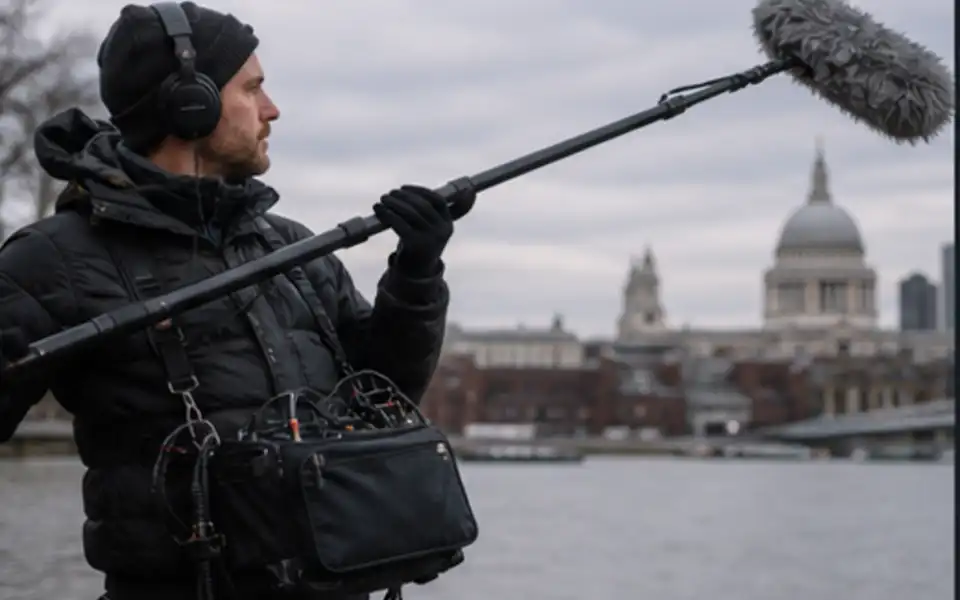
Audio is where low-budget productions most visibly fail. Air conditioning units, open-plan office noise, and corridor acoustics all show up in a microphone. Broadcast productions use boom operators, radio mics with redundancy, and on-set monitoring. A 15dB difference in background noise floor is immediately perceptible to a viewer.
Direction matters for non-actors. Most interview subjects in corporate video are managers, executives, or clients — people who are articulate in conversation but stiffen in front of a camera. A director with broadcast experience will get usable material in two to three takes. Without that, you get ten takes of cautious, stilted delivery that editorial cannot fix.
Post-Production: Timeline and What It Includes
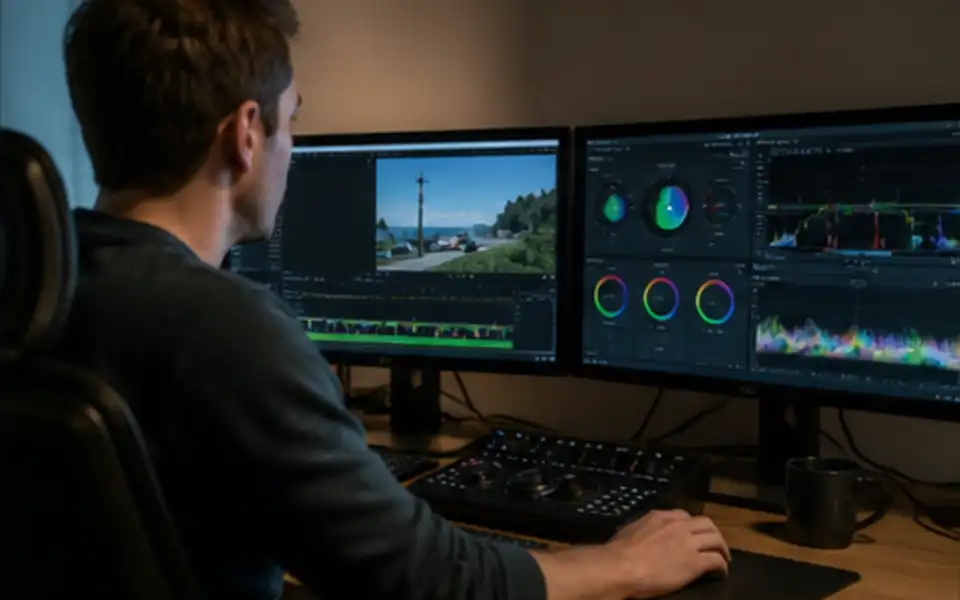
Post-production is frequently where timelines slip because clients underestimate the number of revision rounds. A typical pipeline for a three-minute corporate video looks like this:
| Stage | What Happens | Typical Duration |
|---|---|---|
| Assembly cut | Editor builds first rough cut from all footage | 2–4 days |
| Rough cut review | Client reviews, sends consolidated notes | 3–5 days |
| Fine cut | Changes applied, music placed, colour grade started | 2–3 days |
| Fine cut approval | Second review round | 2–3 days |
| Colour grade and grade review | Final look established | 1–2 days |
| Sound mix | Dialogue, music, and sound effects balanced | 1 day |
| Graphics and titles | Motion graphics, lower thirds, end cards | 1–3 days |
| Final delivery | Multiple export formats for web, broadcast, social | 1 day |
Total: three to five weeks for a standard corporate video with two revision rounds. Projects that run longer almost always do so because feedback from the client side is not consolidated — ten people send ten separate emails, and the editor has to reconcile contradictions.
Request a clear revision policy before signing off. Most professional UK production companies include two rounds in their standard contract. Additional rounds are typically charged at a half-day or day rate.
Broadcast Production vs. Digital-First Video
These require meaningfully different production approaches and should not be treated as interchangeable.
Broadcast production for UK television (ITV, Channel 4, Sky, or streaming platforms) must conform to Ofcom standards, delivery specifications from the relevant broadcaster, and in most cases BARB measurement frameworks. Colour masters are delivered in specific codec formats (usually ProRes 4444 or MXF). Audio must meet EBU R128 loudness standards. Subtitles and AD (audio description) tracks may be required.
Digital-first production is more flexible on technical delivery but needs to be optimised for viewing conditions that broadcast does not share: sound-off autoplay on LinkedIn, vertical format on Instagram, thumbnail readability on YouTube. A single broadcast-standard master does not serve all these placements without recutting.
If your campaign spans both broadcast and digital, build that into the production plan from day one. Trying to repurpose a broadcast master into social content in post is possible but inefficient and usually shows.
Live Event Video Production
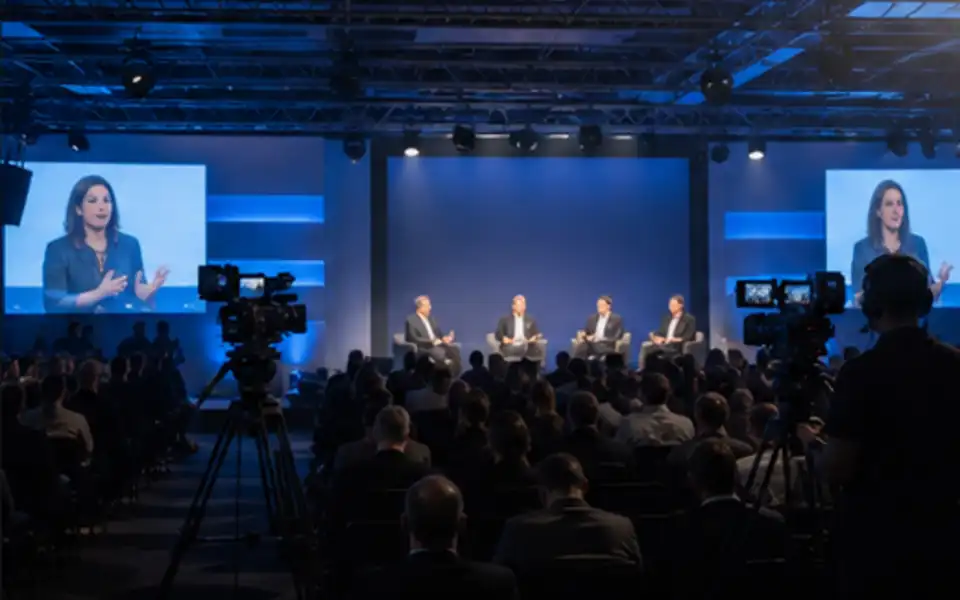
Live event capture is a separate discipline from studio or location production. It involves:
- Multi-camera setups (typically three to six cameras for a conference or award event)
- Live switching or post-event editing
- Graphics integration (lower thirds, presentation overlays)
- Stream encoding for live broadcast or recording for edited highlight packages
For events in London, a competent three-camera setup with a vision mixer, audio engineer, and director runs at approximately £4,000–£8,000 per day, depending on kit requirements. Venues matter: many corporate event spaces are not designed for broadcast lighting, which means additional rig time.
A common error is booking event capture as an add-on to the event production budget rather than giving it its own line. Cameras placed as an afterthought produce footage that cannot be used professionally.
What to Look for When Choosing a UK Production Company
| Factor | What to Check |
|---|---|
| Showreel relevance | Does it include work in your sector or format? |
| Crew structure | In-house or freelance? Freelance is common and fine; ask about director continuity |
| Broadcast credits | For broadcast work, look for verifiable transmission credits |
| Post-production pipeline | Do they edit in-house or outsource? |
| Delivery formats | Can they supply broadcast masters, web versions, and social cuts? |
| Rights and usage | Does the contract transfer copyright or license usage only? |
The rights question is frequently overlooked. Some production agreements retain copyright with the production company and license usage for a defined period. If you intend to use the video in paid advertising or modify it for future campaigns, you need a full buyout or a contract that explicitly permits this.
Budgeting Realistically for UK Corporate Video
Prices vary significantly by region and scope, but as a general orientation for the UK market in 2026:
| Project Type | Typical Budget Range |
|---|---|
| Single talking-head testimonial | £800 – £2,500 |
| Brand overview video (1–2 min) | £5,000 – £15,000 |
| Product demo with location shooting | £4,000 – £12,000 |
| Multi-location case study | £8,000 – £20,000 |
| Broadcast commercial (30 sec) | £15,000 – £60,000+ |
| Live event capture (1 day) | £3,500 – £10,000 |
These ranges assume professional crew, proper pre-production, and broadcast-quality delivery. Figures at the lower end typically involve smaller crews, single locations, and limited post-production. The upper ranges include agency-level direction, motion graphics, and multiple delivery formats.