title: Production Services for Broadcast, Corporate Video and Live Events description: SMG Productions offers end-to-end production services across broadcast TV, corporate video and live events. Crew, kit, post-production and delivery — all under one roof in the UK. language: en-GB geo: United Kingdom
SMG Productions provides full-cycle production services across broadcast television, corporate content and live event coverage. From initial brief to final delivery, every stage is handled in-house — reducing handover risk and keeping timelines tight. Whether you need a single camera operator for a half-day shoot or a complete production team for a multi-camera live broadcast, the service scales to the project.
What Production Services Actually Cover
The term "production services" is used loosely across the industry. Here it means something specific: crew, equipment, direction, post-production and technical delivery — coordinated as a single workflow rather than assembled from separate vendors.
Core service areas:
- Pre-production — scripting support, shot lists, location recces, scheduling, risk assessments
- Camera and crew — director, DoP, camera operators, sound recordists, runners
- Equipment supply — broadcast-grade cameras, lighting rigs, grip, radio mics, prompter
- Live event production — multi-camera switching, live graphics, IMAG, streaming
- Post-production — offline edit, online grade, sound mix, motion graphics, versioning
- Broadcast delivery — AS-11, IMF, ProRes, MXF, and platform-specific specs
Using a single production company across all stages cuts miscommunication between departments and typically reduces overall project cost by 15–25% compared to sourcing crew and post separately.
Broadcast Production
What "broadcast-standard" means in practice
Broadcast clients — whether commissioning editors at Channel 4 or in-house teams at Sky — have technical delivery requirements that go beyond "looks good on screen." Codecs, colour space, loudness normalisation (EBU R128), closed captions, and delivery format all need to match spec before anything reaches a tx suite.
SMG Productions works to broadcast technical standards as a default, not an upgrade. That includes:
| Requirement | Standard Applied |
|---|---|
| Audio loudness | EBU R128 (-23 LUFS integrated) |
| Colour space | Rec.709 for HD; Rec.2020 for UHD |
| Frame rate | 25fps / 50fps (UK broadcast) |
| Delivery format | AS-11 DPP for UK broadcasters |
| Subtitles | EBU-TT-D or STL depending on platform |
Getting these wrong means a rejected delivery. Getting them right first time is the baseline expectation for any production company working in the UK broadcast space.
Typical broadcast projects
- Documentary inserts and feature packages
- Corporate-funded programmes for channel placement
- Sports and events coverage for broadcast rights holders
- Continuity and identity shoots for broadcast brands
- Talking head interview series for factual programming
Corporate Video Production
Where corporate video fits in a production workflow
Corporate video is not a single format. It spans internal communications, external brand content, investor relations, product launches, training modules and executive interviews. Each has different requirements — in terms of tone, technical spec and distribution platform.
A 90-second brand film for a FTSE 250 company going on LinkedIn needs different treatment than a 12-part compliance training series hosted on a learning management system. Both are "corporate video." The production approach, shooting ratio and post workflow are not the same.
Common corporate formats and what they involve
| Format | Typical Duration | Key Production Considerations |
|---|---|---|
| Brand / culture film | 60–180 seconds | High production value, music licensing, colour grade |
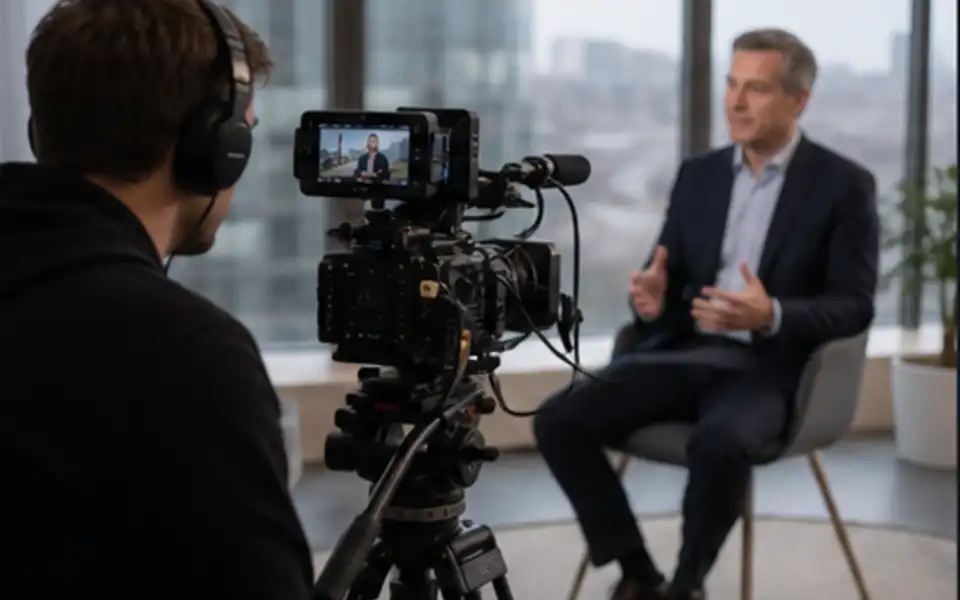
| Executive interview | 3–8 minutes | Controlled lighting, autocue, clean audio |
| Product launch video | 90–240 seconds | Lifestyle or demo footage, motion graphics |
| Training / e-learning | 5–20 minutes per module | Multi-module structure, on-screen graphics, versioning |
| Internal comms | 1–3 minutes | Quick turnaround, branded lower thirds |
| Case study / testimonial | 2–5 minutes | Location shoot, B-roll, interview with client |
One factor that corporate clients often underestimate is versioning. A brand film shot in one day may need to be delivered in six formats: 16:9 for YouTube, 1:1 for Instagram, 9:16 for Reels and Stories, a 30-second cut, a 15-second cut, and a version with subtitles burned in. That versioning work happens in post — and it needs to be scoped and budgeted at brief stage, not treated as an afterthought.
Live Event Production
Multi-camera live events: what the setup looks like
Live event production involves more technical coordination than a standard shoot because everything happens in real time. There is no second take for a keynote address or a product reveal. The production infrastructure needs to be right before the event begins.
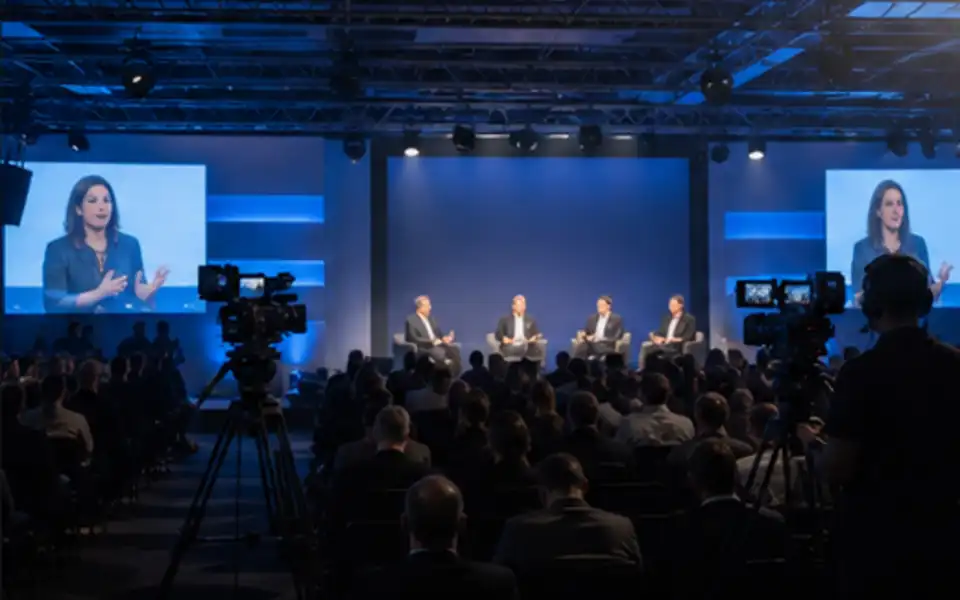
A typical multi-camera live event setup might include:
- 3–6 broadcast cameras (robotics available for fixed positions)
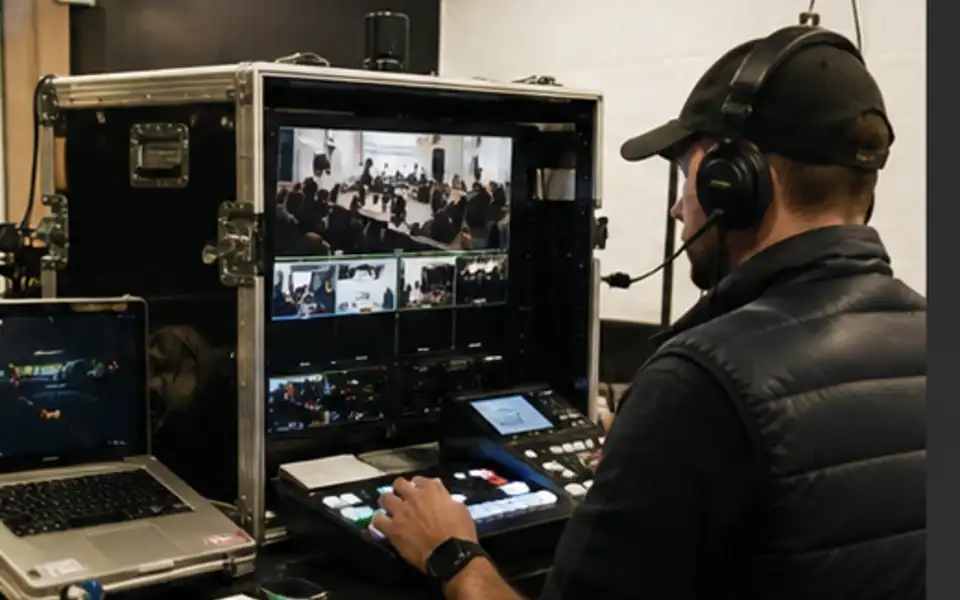
- Vision mixer (live switching, cut to programme)
- Graphics operator (live lower thirds, full-screen slides)
- Audio desk and PA integration
- Confidence monitoring for speakers
- IMAG (image magnification) for large venues
- Live stream encoder and CDN distribution
- Recording to archive (ISO recordings of each camera feed)
Streaming and hybrid events
Since 2021, hybrid events — where a live audience is joined by a remote online audience — have become a standard format rather than an exception. The production requirements for hybrid are more complex than either a purely live or purely online event: you need broadcast-quality encoding, stable internet infrastructure (often a dedicated bonded connection), a platform that handles scale, and someone managing the online audience experience separately from the floor director managing the room.
Streaming platforms commonly used in UK corporate events:
- Vimeo Live (brand-controlled, ad-free)
- Brightcove (enterprise, DRM-capable)
- YouTube Live (high reach, less control)
- Microsoft Teams Live Events (internal audiences, Office 365 integration)
- Custom RTMP endpoints to proprietary platforms
Latency, buffering and audio sync are the three most common failure points in live streaming. All three are preventable with proper pre-event testing and redundant signal paths.
Post-Production Services
Post-production is where footage becomes content. The edit is not just about assembling shots — it is about pacing, narrative structure, sound design, colour and the overall impression the finished piece makes on its audience.
What the post workflow includes
Offline edit — assembly and fine cut, working from selects or a full paper edit. This is where structure is determined.
Online / conform — high-resolution master is assembled from camera originals (not proxies), ready for grade and delivery.
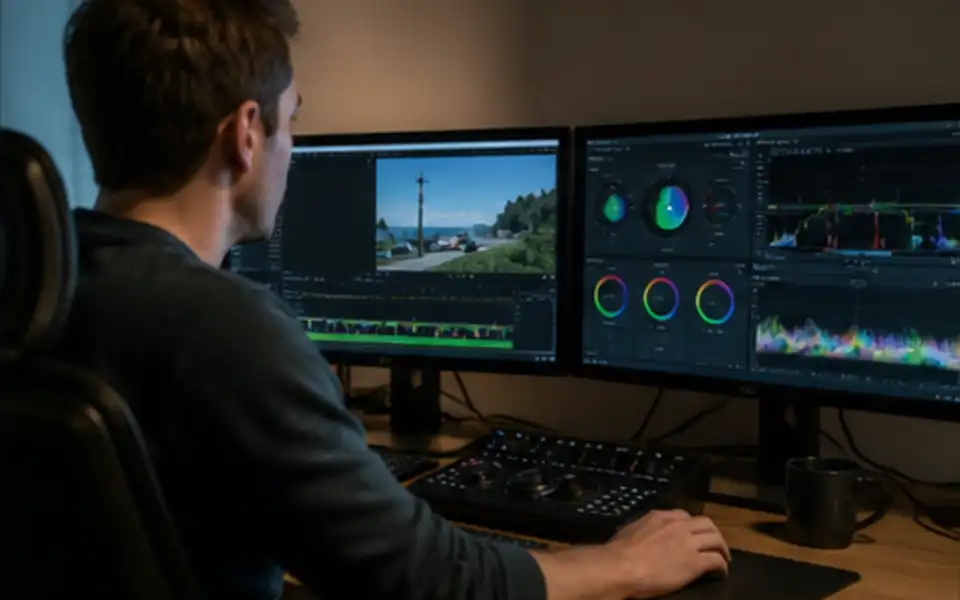
Colour grade — not just "correcting" footage but establishing a visual language consistent with the brand or editorial tone of the project.
Sound mix — dialogue levels, music balancing, ambient sound, effects, final loudness pass to spec.
Motion graphics — titles, lower thirds, animated logo treatments, infographic sequences, full-screen graphics.
Versioning and delivery — cutting different durations, reformatting for different aspect ratios, exporting to platform specs, uploading or packaging for delivery.
A common production mistake is compressing the post schedule to save budget, then running out of time for sound and grade. The grade on a 3-minute corporate film typically takes 4–6 hours. The sound mix takes 2–4 hours. These are not optional steps — they are what separates a polished deliverable from footage with a title card on it.
Equipment and Crew
Production quality depends on the people as much as the kit. The camera used matters far less than the person operating it, the person lighting the scene and the director making creative decisions.
Crew available through SMG Productions:
- Directors and executive producers
- Directors of photography
- Camera operators (single and multi-camera)
- Broadcast sound recordists
- Lighting technicians and gaffers
- Edit producers and offline editors
- Colourists
- Motion graphics designers
- Live event technical directors and vision mixers
Camera systems used include Sony VENICE 2, Sony FX9, ARRI Amira and Canon C70 depending on project requirements. Lens choices, support rigs and lighting packages are specified at pre-production stage based on location, format and budget.
Budgeting for Production Services
One of the most common questions from clients new to commissioning video: what does it cost? The honest answer is that it depends on scope. But there are useful benchmarks.
| Project Type | Approximate UK Budget Range |
|---|---|
| Single-camera corporate interview (half day) | £1,200 – £2,500 |
| 90-second brand film (1 day shoot, full post) | £8,000 – £18,000 |
| Multi-camera live event (1 day, 500 delegates) | £12,000 – £30,000 |
| Broadcast documentary insert (3–5 mins) | £15,000 – £45,000 |
| Training video series (6 x 10-minute modules) | £25,000 – £60,000 |
These are directional ranges, not quotes. A brand film shoots in a controlled studio environment with a small cast costs very differently from the same duration shot on location over two days with a larger crew. The spec drives the cost — not the other way around.